Affiliate Disclosure & Earnings Disclaimer are found at the bottom of this page
One afternoon, I had been scrolling Amazon for hours trying to figure out which products were worth filming.
I’d click through categories, read reviews, check video slots, and try to guess which items would actually convert. Most of the time, I had no way to know if I was making the right choices.
I then started filming product videos with no data to tell me if it was even worth the effort. (To be fair, I was predominantly recording all of the books in my book collection—not exactly a data-driven strategy.)
The problem wasn’t my video quality. The problem was my product selection had no data behind it.
And after the April 2026 commission changes cut halo sales, I knew I couldn’t afford to waste time on products that wouldn’t perform (HALO Sales stands for commission made through other products in a shopping cart that were purchased simultaneously during the checkout process after watching your video).
The commission structure shifted, and suddenly every video decision mattered more. I needed a better system.
That’s when I stumbled upon and started using Viral Vue.
What Viral Vue Actually Is
Viral Vue is a tool built specifically for Amazon influencers and affiliates. It has data on over 30 million products, and it gives you the information you need to make smarter product decisions before you hit record.
The main feature is a Chrome extension that overlays product data directly on Amazon pages while you browse. You don’t have to leave Amazon or juggle spreadsheets. The data shows up right where you’re already working.
It also includes AI-powered automation for Creator Connections campaigns, which I’ll get to in a minute.
You can sign up for free at viralvue.com — no credit card required. If you decide to upgrade to a paid plan, use code WELCOME10 for 10% off.
My Product Selection Strategy: What I Actually Look For
I developed my approach from several weeks of use and from another influencer who gave a product demo of Viral Vue. Based on that demo and my own research over time, here’s what I focus on:
Sales velocity and volume come first. I’m looking for products that are moving—ideally at least 1,500 product sales per month or higher. Strong sales velocity tells me there’s real buyer demand.
Then I check influencer video competition. I want to find products with high sales but low video counts. That’s the sweet spot—high demand, low creator saturation. If I can find a product doing 1,500+ monthly sales with relatively few competing videos, that’s an opportunity.
Carousel placements matter too. Whether it’s top or bottom carousel placement, if there are open slots and I can get my video in there, I might be lucky enough to get selected by Amazon’s algorithm to be featured.
Viral Vue shows me all of this data in one place:
-
Monthly sales estimates (I’m targeting 1,500+ per month minimum)
-
Total influencer videos already on the listing
-
Carousel placement availability (top vs. bottom, number of slots)
-
Review count and rating
-
The Viral Score (a composite metric that factors in these data points)
The Viral Score is helpful as a quick reference, but I’m really digging into the individual metrics—especially sales velocity and video competition. Those two factors tell me whether a product is worth filming.
But here’s the reality: At the end of the day, it’s a bit of a gamble whether Amazon’s algorithm will actually feature your video. You can find a product with perfect metrics—high sales, low competition, open carousel slots—and there’s still no guarantee you’ll be selected for placement.
Video creation can be fruitful or not. It just depends on the system.
That said, using data to guide my decisions feels infinitely better than filming blind. I’d rather take calculated risks on high-potential products than waste time on listings with no data behind them.
Especailly considering thaty you are spending money on goods to actually record product videos.
Before Viral Vue, I was filming books from my personal collection with zero strategy. Now I have data guiding every decision—even if the outcome is still somewhat out of my control.
What the Data Actually Shows
After running product research through Viral Vue across a sample of listings, a few consistent patterns showed up that changed how I think about product selection.
Not to mention, that now when I need to make a purchase – I do so, with the intention of grabbing a product that performs well and will suit my needs.
Estimated monthly sales frequently ranged from hundreds to several thousand units per month, with multiple products exceeding 1,000+ monthly sales.
Daily sales velocity on strong performers often exceeded 30-50 units per day.
A lot of these high-demand products had fewer than 300 competing influencer videos. So that could potentially be a good product, some people even go for products that have a lower influencer video count.
The favorable sales-to-video ratio really is a subject thing, and you will determine your threshold once you start buying and recording shoppable videos for amazon.
Obviously prioritizing strong buyer demand, and low creator saturation, of course…
Other patterns I noticed:
-
High sales volume doesn’t automatically mean high influencer competition
-
Products with lower competition frequently offer greater visibility opportunities
-
Some listings support hundreds of monthly purchases while maintaining manageable creator saturation
-
Strong sales velocity creates more consistent opportunity than chasing high-ticket items alone
-
Certain products continue generating demand long after publication — recurring commissions from a single video
-
Competition levels vary dramatically by niche, meaning some categories are far less saturated than others
The conclusion I keep coming back to: product selection may be just as important as video production itself.
Note: These observations are based on a sample of product data reviewed through Viral Vue at a specific point in time. Marketplace conditions change, and individual results will vary based on niche, timing, content quality, and many other factors.
Product Vue: The Table View That Changed Everything
Product Vue is the table-based dashboard that pulls all relevant product data from whatever Amazon page you’re on.
It shows:
-
Total influencer videos already on a product
-
Creator Connections campaign status
-
Viral Score
-
Price and category
-
Review count and rating
You can filter and sort by any of these metrics. If I want to find products with high Viral Scores, low video competition, and active Creator Connections campaigns, I can do that in about 30 seconds.
I can also export the results to plan my filming schedule or batch out a week’s worth of content decisions in one sitting.
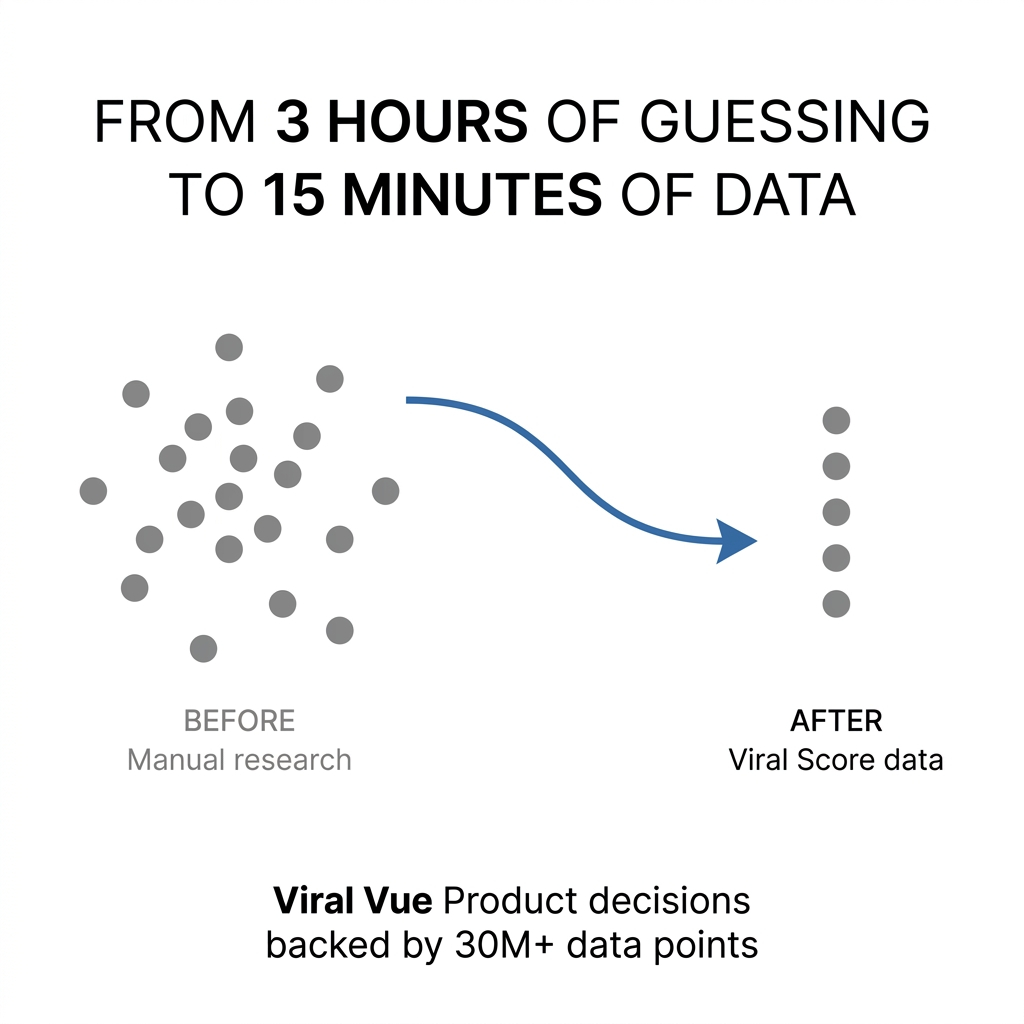
This feature alone has cut my research time from hours to minutes. I used to open dozens of tabs, copy data into a spreadsheet, and manually compare products. Now I just open Product Vue and sort by the metrics that matter.
Why Catalog Size Compounds Over Time
One of the most useful ways to think about this program is through a catalog lens. The more data-backed products you add to your video library, the more buyer demand you’re exposed to.
Here’s a simple illustration of how catalog size scales your potential reach:
| Catalog Size | Videos Published | Estimated Monthly Product Demand Represented* | Strategic Advantage |
|-------------|------------------|-----------------------------------------------|--------------------|
| 100 Products | 100 Videos | 100,000+ Monthly Product Sales | Initial diversification across multiple listings |
| 200 Products | 200 Videos | 200,000+ Monthly Product Sales | Greater exposure to buyer demand |
| 300 Products | 300 Videos | 300,000+ Monthly Product Sales | Increased commission consistency potential |
| 500 Products | 500 Videos | 500,000+ Monthly Product Sales | Significant catalog diversification |
| 1,000 Products | 1,000 Videos | 1,000,000+ Monthly Product Sales | Large-scale marketplace exposure |

*Illustrative example assuming an average of approximately 1,000 monthly sales per product listing.
*Illustrative example only, assuming an average of approximately 1,000 monthly sales per product listing. Actual product demand and individual commissions earned will vary. These figures are not a projection of earnings you should expect to achieve.
And here’s how even modest per-product earnings can compound across a growing portfolio:
| Catalog Size | Average Earnings Per Product Per Month | Portfolio Earnings Potential |
|-------------|-----------------------------------------|-----------------------------|
| 100 Products | $2 | $200/month |
| 100 Products | $5 | $500/month |
| 100 Products | $10 | $1,000/month |
| 300 Products | $2 | $600/month |
| 300 Products | $5 | $1,500/month |
| 300 Products | $10 | $3,000/month |
| 500 Products | $2 | $1,000/month |
| 500 Products | $5 | $2,500/month |
| 500 Products | $10 | $5,000/month |
| 1,000 Products | $2 | $2,000/month |
| 1,000 Products | $5 | $5,000/month |
| 1,000 Products | $10 | $10,000/month |
These are hypothetical illustrations only. They are not a representation of typical earnings, a guarantee of results, or a projection of what you will earn. Your actual results will depend on your own effort, consistency, product selection, niche, and many other individual factors.
This is why data-driven product selection matters so much. You’re not just picking one product — you’re building a catalog. Each video you film with solid data behind it is a long-term asset. Each video you film on a hunch is a gamble.
Creator Connections Automation: The Time-Saver I Didn’t Know I Needed
Creator Connections campaigns are where the real money is. Instead of earning the standard 2-4% commission, you can earn bonus commissions ranging from 10% to 50% on top of base rates.
The problem is that finding, accepting, and submitting content for these campaigns used to take hours. You’d have to manually search the Creator Connections dashboard, accept campaigns one by one, and then remember to submit your videos.
Viral Vue automates the entire process.
You set your preferences once, and the tool automatically finds campaigns that match your criteria, accepts them, and submits your content. What used to take a couple of hours every week now takes a few clicks.
I run the automation twice a week. The tool can also be scheduled to run overnight so you don’t have to watch it — it just works in the background while you do other things.
Connecting Product Selection to Real Earnings
In my survey of Amazon influencers (covered in detail in my Amazon influencer earnings research article), monthly income ranged from less than $50 to over $20,000 per month. The gap between those outcomes isn’t just about how many videos someone published.
Creators with only a few dozen randomly selected videos reported earning little or nothing. Others with hundreds of strategically selected videos reported monthly earnings in the hundreds or thousands. Top performers with catalogs exceeding 1,000 videos reported earnings above $20,000 per month.
These figures were self-reported by survey participants and reflect a wide range of individual outcomes. They are not typical results and are not a prediction of what you will earn.
The combination that appears to separate lower earners from higher earners:
-
Catalog size
-
Product selection quality
-
Consumer demand behind each product
-
Competition levels at the time of filming
-
Commission value per product category
-
Sales velocity and long-term demand stability
Marketplace intelligence tools like Viral Vue help you address most of these variables before you ever hit record. That’s the advantage.
The Before and After: My Honest Experience
Here’s what my workflow looked like before Viral Vue:
-
Scroll Amazon for 2-3 hours trying to find products
-
Open dozens of tabs and manually check video slots
-
Copy product data into a spreadsheet
-
Guess which products would convert
-
Film videos with no confidence they’d perform
-
Manually search Creator Connections campaigns
-
Miss trending products because I didn’t see them early enough
Here’s what it looks like now:
-
Open Viral Vue and scan for products with 1,500+ monthly sales
-
Filter Product Vue by high sales velocity and low influencer video competition
-
Add a list of 20-30 products to film to my shopping cart
-
Let the Creator Connections automation handle campaigns
-
Film with confidence that the products have real potential
-
Get early access to trending products before they’re oversaturated
The difference is significant—and it’s changed how I approach filming even though I’m still early in the process.
Where I Am Right Now (The Honest Truth)
Full transparency: I haven’t made any sales yet. As of June 11, 2026, I’ve recorded 146 product videos using Viral Vue’s data to guide my product selection.
Here’s the thing I learned the hard way: I didn’t wait for my first three product videos to be approved before I kept filming. That’s a requirement for on-site Amazon shoppable video approval, and I missed it. So right now, I’m waiting for that approval before I can re-upload my videos.
It’s a rookie mistake, but it’s an honest one—and I’m sharing it because I want you to know exactly where I stand. I’m not writing this from a place of massive success. I’m writing this as someone who’s using the tool, learning the system, and building my catalog the right way (even if I had to learn a lesson first).
The 146 videos I’ve filmed? They’re mostly all data-backed. I’m confident in the product selection because I used Viral Vue to identify high-opportunity items before I hit record. Now I’m waiting for approval so I can get them uploaded and start seeing results.
So no, I can’t tell you I’ve made thousands of dollars. But I can tell you that using data to guide my product decisions feels infinitely smarter than the guessing game I was playing before.
Why I started with Viral Vue from day one: I didn’t want to make costly mistakes. After conducting empirical research on Amazon influencers who are actually performing well in the on-site shoppable videos program (covered in detail in my Amazon influencer earnings research article), one pattern was crystal clear: the creators earning consistent income weren’t guessing. They were strategic about product selection, and they understood the data behind buyer demand and competition levels.
I decided to start this journey with that intelligence built in from the beginning. I didn’t want to waste six months filming random products only to discover I’d been targeting oversaturated listings or low-demand items. Viral Vue gives me the same data advantages that top performers have figured out through trial and error—except I get it upfront.
Why This Matters More Than Ever in 2026
The April 2026 commission changes hit a lot of creators hard. Halo sales are gone, and the fixed commission rates across most categories dropped significantly.
If you were depending on cart upsells to pad your earnings, you probably saw a 10-25% revenue drop. The creators who are still growing are the ones who’ve adapted. They’re using data to make smarter decisions about which products to cover rather than filming randomly and hoping for the best.
Every video you film needs to have a real chance of generating commissions. That’s where having the right data upfront changes how you work.
The Reality Check: This Tool Isn’t Magic
I want to be clear: Viral Vue won’t make you money if you don’t put in the work.
You still need to film videos. You still need to upload consistently. You still need to test different products and see what resonates.
But if you’re serious about scaling your Amazon influencer income, this tool will save you time and help you make better decisions. I use it myself. It’s part of my workflow, and I can’t imagine going back to manual product research.
How to Get Started with Viral Vue
Viral Vue is free to start — no credit card required.
You can create an account, install the Chrome extension, and start using the Viral Score and Product Vue features right away. If you want access to the Creator Connections automation and advanced features, there’s a paid plan available. Use code WELCOME10 at checkout for 10% off.
Here’s what I recommend:
-
Install the Chrome extension
-
Browse Amazon like you normally would and watch the Viral Scores appear on product pages
Open Product Vue on a category page and sort by sales velocity
-
Look for products with 1,500+ monthly sales and low video competition, then export a list of 10-20 to film
-
Run the Creator Connections automation twice a week to capture higher-commission campaigns automatically
If you’re creating videos without data, you’re making it harder than it needs to be. Viral Vue won’t do the work for you, but it will show you where to focus your energy — and in 2026, that’s the difference between creators who are growing and creators who are stuck.
Ready to stop guessing and start using data? Sign up for free at Viral Vue — no credit card required. And if you upgrade, use code WELCOME10 for 10% off your first plan.
Affiliate Disclosure: This post contains affiliate links. If you sign up for Viral Vue through my link, I may earn a commission at no additional cost to you. I only recommend tools I personally use and believe in.
Earnings Disclaimer: The data points, figures, and examples referenced in this article are for illustrative and informational purposes only. They do not represent typical results and should not be interpreted as a guarantee or promise of income. Results vary significantly based on individual effort, experience, niche, product selection, content quality, audience size, and many other factors outside anyone’s control. Any income figures shared — whether from surveys, third-party reports, or illustrative models — reflect a range of possible outcomes, not averages or expectations. Nothing in this article constitutes financial, legal, or business advice. You are solely responsible for your own results. Inspiredtoblog.com and its owner expressly disclaim any liability for outcomes resulting from the use of information or tools referenced in this article.