Meta description: Learn how cleaning content creators qualify for the Amazon Influencer Program, build shoppable videos and storefronts, stack commissions, and earn realistic monthly income from content they already make.
I spend a lot of time reverse-engineering how digital assets produce recurring income. Every so often I find a system that fits one niche so cleanly that I have to document it. This is one of those times.
If you create cleaning content, you already film product demos. You show a stain lifting, a grout line coming back to life, a cluttered pantry turning into something organized. The Amazon Influencer Program pays you for exactly that footage, placed directly on Amazon product pages where shoppers are seconds away from checkout.
Here is the part that caught my attention when I mapped this out: cleaning is a growth category. Household cleaning product sales on Amazon have grown 30% year-over-year, and shoppers in that category actively look for proof before they buy. Your videos are that proof.
In this guide I’ll walk you through the full path: how to apply and qualify, how onsite shoppable videos work, how to build your storefront and idea lists, how Creator Connections adds brand deals on top, and how commission stacking turns one video into multiple income streams. I’ll also keep the earning expectations honest, because vague promises help nobody.
How the Amazon Influencer Program Actually Works
The Amazon Influencer Program is an extension of Amazon Associates built for creators. You get two core assets:
-
A personal Amazon storefront with a custom URL where you curate products, lists, and videos.
-
Onsite placement rights, which means your shoppable videos can appear directly on Amazon product detail pages.
That second asset is where the money lives. Shoppable product videos placed on listings, rather than social media traffic, generate the majority of income for creators in this program. On-site video commissions make up 60 to 80% of earnings for active influencers.
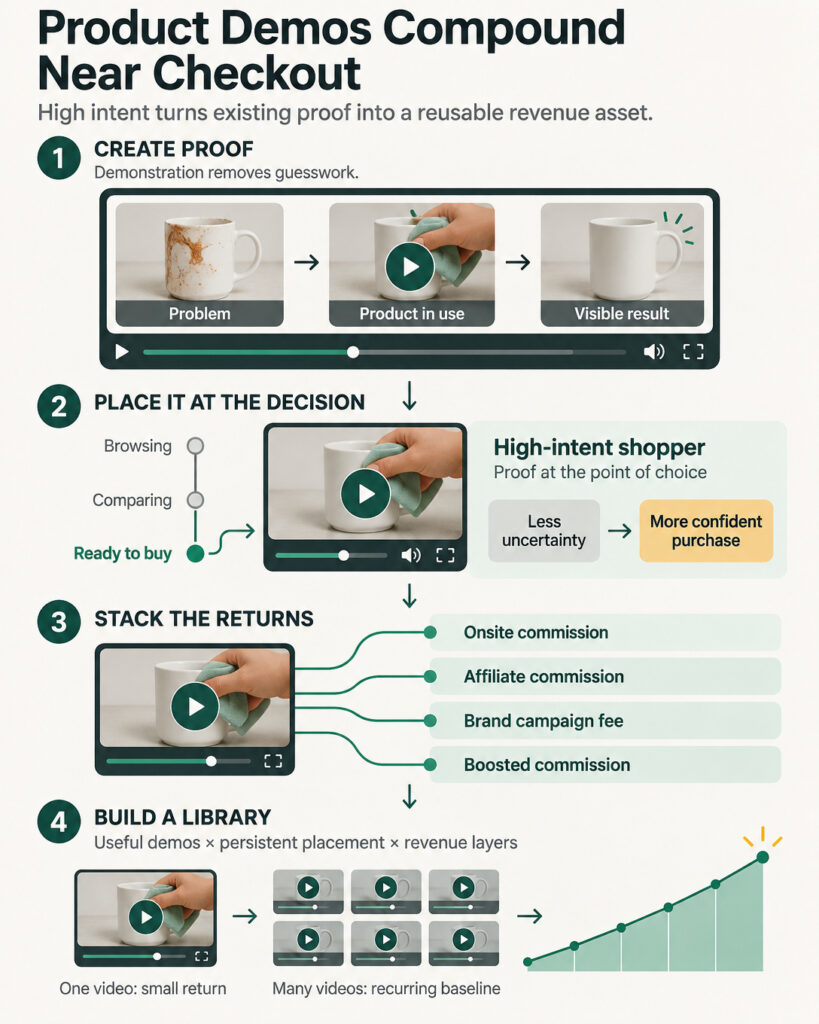
Think about what that means structurally. You film a 1 to 5 minute review of a scrub brush or a steam mop. Amazon places it on that product’s page. A shopper who is already deciding whether to buy watches your demo, sees it work, and clicks Add to Cart. You earn a commission on that sale, and on qualifying items in the same order.
Your video becomes a small asset that works around the clock. That is the kind of system I teach my students to build everywhere in their business.
Step 1: Apply and Qualify
You apply through the Amazon Influencer Program page using an existing Amazon account. Amazon reviews your social presence on one of four platforms: Instagram, TikTok, YouTube, or Facebook.
What Amazon looks for
Amazon does not publish a hard follower minimum. Based on the data available, creators with engaged niche audiences in the 20,000 to 50,000 follower range who post product-related content 2 to 3 times a week represent a typical accepted profile. Smaller accounts get in regularly when engagement is strong.
Here is what works in your favor as a cleaning creator:
-
Your content is already product-centered. Amazon wants creators who feature products naturally. Cleaning demos do this by default.
-
Engagement matters more than raw size. Comments asking “what product is that?” are exactly the signal Amazon wants to see.
-
Consistency counts. A steady posting history reads as reliability.
The second gate: onsite video approval
Getting accepted into the program is step one. To unlock onsite placement, you submit three sample product videos for review. Amazon checks for clear audio, honest review style, good lighting, and visible product demonstration.
Take this submission seriously. Film the three videos as if they were already live on a product page. Show the product in use, state what it does well, mention one honest limitation, and keep it between 60 seconds and 3 minutes.
💡 Tip: Pick products you already own and use in your routines. Authenticity is visible on camera, and it is also what converts.
Step 2: Film Product Demos as Onsite Shoppable Videos
Once approved for onsite placement, every video you upload can appear on the matching product’s detail page. This is where cleaning content has a structural advantage over almost every other niche.
Cleaning results are visual and immediate. A before-and-after shot of a burnt pan or a hard water stain communicates value faster than any written review. The data backs this up: shoppable influencer videos deliver a 2.4x conversion lift over standard Amazon product listings, and home-related content performs at the top of that range.
A simple repeatable video formula
-
Open on the problem. Show the mess, the stain, the clutter. Three seconds, no intro.
-
Introduce the product. Name it clearly and show the packaging.
-
Demonstrate in real time. Over-the-shoulder footage of the product working. This is the core of the video.
-
Show the result. Clean surface, side by side with the before shot if you can.
-
Give an honest verdict. What it does well, who it suits, one thing to know before buying.
One more detail worth knowing: watch time is now the strongest predictor of whether Amazon features your video in the carousel on a product page, outperforming conversion rate by a factor of six. Keep viewers watching by getting to the demonstration fast and cutting dead air.
Volume is the real strategy
Single videos earn small amounts. Libraries earn real income. Creators who earn consistently typically have 50 to 200 live videos across a range of products. The published volume benchmarks look like this:
-
50 to 100 videos: roughly $150 to $500 per month
-
100 to 200 videos: roughly $300 to $1,500 per month
-
200 to 400 videos: roughly $1,000 to $3,000 per month
One influencer with about 1,100 shoppable videos reported earning $2,000 to $4,000+ per month. Treat this like a content production system. Batch film five demos in one afternoon. Every bottle under your sink is a potential video.
Step 3: Build Your Storefront and Idea Lists
Your storefront is your curated shop. For a cleaning creator, it becomes the single link you share everywhere: your bio, your blog, your video descriptions.
How to structure it
Organize with idea lists, which are themed collections of products. Useful structures for cleaning creators include:
-
My Weekly Cleaning Caddy
-
Deep Clean Day Essentials
-
Spring Cleaning Checklist
-
Eco-Friendly Swaps That Actually Work
-
Small Apartment Organization Finds
That eco-friendly list deserves priority. Amazon’s cleaning category data shows growing consumer demand for hypoallergenic, concentrated, and eco-friendly products. Curating that list positions you inside an expanding search trend.
Update your lists seasonally. A holiday hosting prep list in November and a spring cleaning list in March keep your storefront current and give you fresh content to promote. Q4 matters here: influencers routinely report earnings of 3 to 5x their normal monthly average during Black Friday, Cyber Monday, and holiday shopping.
Step 4: Add Creator Connections Campaigns
Once you are active in the program, you gain access to Creator Connections, Amazon’s internal marketplace where brands post paid campaigns directly to qualified creators.
Released in 2023, Creator Connections lets brands brief and pay creators for on-Amazon content tied to specific products, all managed inside Amazon’s system. Campaigns pay flat fees ranging from $100 to $5,000 per post, and some brands add boosted commissions of up to 50% on top of your standard affiliate rate.
Published rate benchmarks by audience size:
-
1K to 10K followers: $100 to $500 per post for one shoppable video plus one static post or story
-
10K to 50K followers: $500 to $1,500 per post for one to two shoppable videos, onsite video, or a Reel with tagged products
Cleaning brands actively use this marketplace because the category is competitive and demonstration content drives their listings. A niche cleaning creator with proof of strong demo videos is exactly who these campaign briefs target.
Step 5: Stack Your Commissions
This is where the system compounds. One cleaning video can earn through four layers at once:
-
Onsite commissions when your video appears on product pages. These run at roughly half the standard offsite rate, around 3% for Home categories, so a $100 sale earns you $3.00.
-
Standard affiliate commissions when you drive traffic from social media or your blog to your storefront, at the full category rate of roughly 3 to 6% for Home and related categories.
-
Creator Connections flat fees for brand campaigns.
-
Boosted brand commissions stacked on top of your regular rate when a Creator Connections brand sets a bonus percentage.
⚠️ Keep expectations realistic. Onsite rates are small per sale. A $15 bottle of cleaner earns you under fifty cents. The system works through volume, mid-priced products, and multiple income layers running at once. One creator on Reddit reported about $1,000 per month with 300 to 500 videos featuring items priced between $40 and $200. Price point matters. Steam mops, vacuums, and carpet cleaners earn more per sale than spray bottles.
A realistic timeline for a cleaning creator posting consistently: $500 to $2,000 per month within 3 to 6 months of joining, scaling from there as your video library grows.
Why This Fits Cleaning Creators So Well
I keep coming back to one principle in my own business: systems beat motivation. The Amazon Influencer Program rewards the exact behavior cleaning creators already practice. You demonstrate products, you post consistently, and you build trust through visible results.
The broader market supports the timing. Amazon-affiliated creator content accounts for an estimated $4.1 billion of 2026 spend, and Creator IQ tracked a 22% median income rise for creators in Q1 2026, driven largely by short-form video traffic to storefronts.
The path is visible. Apply, submit three strong demo videos, build your library in batches, organize your storefront with seasonal idea lists, and layer in Creator Connections campaigns once you have proof of performance. Each step is documented, repeatable, and built on content you already know how to make.
Your next move is simple: pick three cleaning products from under your sink and film your application videos this week.
FAQ: Amazon Influencer Program for Cleaning Creators
How many followers do I need to qualify?
Amazon publishes no fixed minimum. Engaged niche accounts get accepted at smaller sizes, and 20,000 to 50,000 engaged followers posting product content 2 to 3 times a week is a typical accepted profile. Engagement rate carries more weight than follower count.
How much can a cleaning creator realistically earn?
Consistent mid-tier creators posting shoppable video regularly land in the $500 to $3,000 per month range. Expect $500 to $2,000 per month within 3 to 6 months if you post consistently and build toward 100+ live videos. Q4 earnings often run 3 to 5x the normal monthly average.
Do my videos have to be on Amazon products I bought there?
You upload videos for specific products in Amazon’s catalog. Owning and genuinely using the product makes your review honest and your demo convincing, which directly affects watch time and conversion.
What commission rate do I earn on cleaning products?
Home category products earn roughly 3 to 6% on standard offsite affiliate sales. Onsite video commissions run at about half the offsite rate, so a $100 Home category sale through an onsite video earns about $3.00.
How long do videos need to be?
Shoppable videos run 1 to 5 minutes. Shorter videos with strong watch time perform best, since watch time is the top factor in carousel placement on product pages.
Is Creator Connections available right away?
Access opens once you are an active, qualified member of the Influencer Program. Build your onsite video library first, since brands review your existing content before approving you for campaigns.
Can I do this alongside a blog?
Yes, and I recommend it. Embed your shoppable videos in blog posts, link your storefront in product roundups, and earn full offsite commission rates on that traffic while your onsite videos earn separately. The two assets reinforce each other.