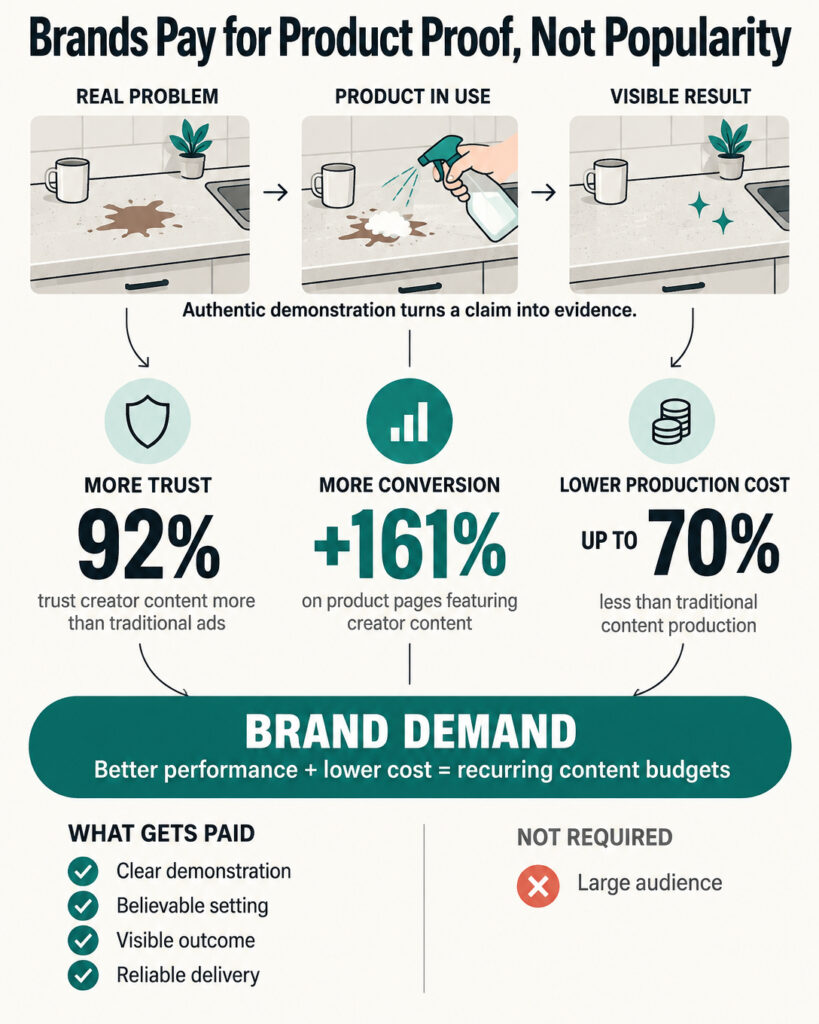
Meta description: Brands are paying creators for user-generated content because it converts better and costs less than studio production. Here is the logic behind the UGC boom and the exact first steps for cleaning and home content creators who want in.
I spend a lot of time reverse-engineering how money actually moves in the online content world. When I see a trend that keeps growing year after year, I want to know the mechanics behind it before I recommend it to anyone.
User-generated content, or UGC, passed that test a long time ago.
Right now, brands are actively paying everyday creators to film short videos of products in use. The creators handing them that content are earning real money, often with zero audience of their own. Once you understand why brands want this content so badly, the opportunity stops looking like a gamble and starts looking like a documented process.
That is exactly how I like it. So let me walk you through the brand-side logic first, because once you see why the demand exists, you will know exactly how to position yourself inside it. This applies especially well if you create cleaning or home content, and I will show you why.
What UGC Actually Is (and Why Brands Buy It)
UGC is content that looks like it came from a real customer. A phone-filmed video of someone unboxing a mop, testing a stain remover on a real carpet, or organizing a pantry with a specific product.
Brands license this content and run it in their ads, on their product pages, and across their social channels.
Here is the part that surprises people: you do not need to be an influencer to make it. Brands buy the content itself, so your follower count is irrelevant to the transaction. A creator with 500 followers and solid video skills can charge the same rates as someone with 50,000, because the brand is paying for the asset, and audiences trust everyday people when it comes to product recommendations.
That single fact restructures the whole opportunity. The barrier to entry is skill, consistency, and a phone camera. The path is visible, which means you can walk it.
The Brand-Side Logic: Three Reasons the Money Is Flowing Toward UGC
Brands do not spend money on trends. They spend money on results. UGC keeps winning budget for three measurable reasons.
1. UGC Converts Better Than Polished Content
The numbers here are hard to argue with. Product pages that feature UGC convert 161% higher than pages without it. When visitors actually interact with that content, they convert at rates 102.4% higher than the average site visitor.
And recent data pushes it further. Pages featuring user-generated content generated 6.73x higher conversion rates than pages without UGC in early 2026, a 57% jump from the previous quarter.
Think about what that means from a brand manager’s chair. Every piece of authentic creator content they add to a product page makes the page sell harder. That math gets a marketing budget approved fast.
2. Consumers Trust Real People
According to the American Marketing Association, 92% of consumers trust user-generated content more than traditional advertising.
This tracks with how you and I actually shop. A glossy studio ad tells you what the brand wants you to believe. A video of a regular person scrubbing their actual bathtub with a product tells you what the product actually does.
85% of people find UGC more influential than brand photos or videos when making purchase decisions. Trust has become the currency of online selling, and UGC is how brands buy it.
3. UGC Costs a Fraction of Studio Production
Here is where the economics get interesting. A studio shoot can run anywhere from $10,000 to $100,000 depending on complexity. A creator-made UGC video typically costs a brand $150 to $500 per asset.
Brands save up to 70% on content creation costs by using UGC, and the content delivers a $4 return for every $1 invested.
On the paid advertising side, UGC ads generate 4x higher click-through rates and cut cost-per-click in half compared to traditional ads.
So the brand gets content that performs better, builds more trust, and costs dramatically less to produce. There is no mystery in why the UGC platform market is projected to reach $8.48 billion in 2026. The demand is structural, which means it has staying power.
What This Means for You as a Creator
Now flip the equation to your side of the table.
Brands need a steady supply of authentic product videos. They are willing to pay real rates for them. And the creators supplying that content are building an income stream with numbers like these:
-
Beginners: $50 to $150 per video, with most earning $500 to $1,500 per month within their first one to three months of consistent pitching
-
Experienced creators: $350 to $500+ per video
-
Full-time UGC creators: $48,000 to $72,000 per year on average, with professional creators in the US reporting significantly higher figures as they build repeat clients
Those beginner numbers matter more than the top-end numbers. They prove you can generate income during the learning phase, which keeps momentum alive. And momentum is what turns a side experiment into an income-producing asset.
Why Cleaning and Home Creators Have a Real Edge
If you create cleaning, organizing, or home content, you are sitting in one of the best-positioned niches in UGC right now.
Here is why. Video reviews deliver the biggest conversion lift of any UGC format, a 40 to 60% increase, because they show real-world product use and visible results. Cleaning and home products are built for exactly that kind of demonstration.
A before-and-after of a grimy stovetop. A time-lapse of a closet reorganization. A side-by-side of two carpet cleaners on the same stain. These formats prove a product works in a way no studio ad can replicate.
Brands in the cleaning and home space know this. Their products live or die on visible proof, and you can manufacture that proof in your own kitchen on a Tuesday afternoon.
You also already own the two hardest assets to fake: a real home and genuine familiarity with the product category. Brands pay for authenticity, and yours comes built in.
Your First Steps: A Practical Starting Sequence
I teach systems, so here is the system. Follow it in order.
Step 1: Build a Small Portfolio Before Anyone Pays You
Pick three products you already own. A cleaning spray, an organizer, a vacuum. Film a 30 to 60 second video for each one as if a brand hired you.
Structure each video the same way: show the problem, show the product in use, show the result, add a short spoken takeaway. This is the standard UGC format brands expect, and repeating it builds your skill fast.
💡 Tip: Natural light near a window and a $20 phone tripod will improve your footage more than any editing app. Brands want authentic, well-lit, and steady. Polished studio quality works against you here.
Step 2: Package Your Work So Brands Can Say Yes Quickly
Put your three sample videos in one place. A simple Google Drive folder, a Canva one-pager, or a short portfolio page on your blog all work.
Include your niche (cleaning and home), your formats (demo videos, before-and-afters, testimonial-style reviews), and your starting rate. Begin in the $100 to $150 per video range and raise prices as you book repeat work.
Step 3: Pitch Consistently
Reach out to cleaning and home brands directly through email and Instagram, and sign up for UGC marketplaces where brands post open briefs.
Keep each pitch short. Two sentences on who you are, one link to your portfolio, one clear offer. Then send the next one. Creators who pitch daily during their first 90 days are the ones landing that $500 to $1,500 monthly starting range.
Step 4: Turn Every Delivered Video Into a System
After each paid project, document what worked. Your filming setup, your script structure, your delivery process. You are building a repeatable production system, and that system becomes the asset that scales your rates over time.
This is the same principle I apply to blogging and every other digital income stream I teach: the income follows the system, and the system is something you build once and refine forever.
How UGC Fits Into Your Bigger Creator Business
I want to be clear about where UGC belongs in your strategy, because context matters.
UGC income is active income. You film, you deliver, you get paid. It is one of the fastest ways to generate cash flow as a creator, and that cash flow can fund the slower-building assets like your blog, your email list, and your own digital products.
Treat UGC as the engine that finances your long-term infrastructure. The creators who do best run both tracks at once: UGC pays the bills this month, while the blog and email list compound into recurring income over the next few years.
Start with the three sample videos this week. The demand already exists, the rates are documented, and the path is visible. Your job now is to walk it.
FAQ: UGC for Cleaning and Home Creators
Do I need a large following to get paid for UGC?
No. Brands buy the content itself for their own channels, so your follower count plays no role in the deal. Creators with a few hundred followers charge the same rates as larger accounts when their video quality is strong.
How much can I realistically earn as a beginner?
Based on current industry data, beginners charge $50 to $150 per video and typically earn $500 to $1,500 per month within their first one to three months of consistent pitching. Experienced creators charge $350 to $500 or more per video.
What equipment do I need to start?
A smartphone, a tripod, and good natural light. Brands specifically want content that looks like a real person filmed it at home, so expensive gear adds little value in this niche.
Why are cleaning and home products such a strong niche for UGC?
Video reviews showing real-world use deliver a 40 to 60% conversion lift, the highest of any UGC format. Cleaning and home products produce dramatic visual proof, which makes your content unusually valuable to those brands.
How do I find brands to work with?
Use three channels at once: direct email pitches to cleaning and home brands, direct messages on Instagram and TikTok, and UGC marketplaces where brands post paid briefs. Consistent daily pitching produces the fastest results.
Is the UGC opportunity going to last?
The demand is structural. UGC converts 161% higher on product pages, builds trust with 92% of consumers, and saves brands up to 70% on production costs. The platform market is projected to reach $8.48 billion in 2026. Brands will keep buying content that performs this well.