Meta description: Learn exactly how UGC contracts work: creation fees, usage licenses, whitelisting, exclusivity, revisions, and raw footage. Includes a simple rate-building example so you can price with confidence.
When I started teaching creators how to monetize their content, I noticed a recurring problem. Creators would land a brand deal, feel excited, send over a flat price, and sign whatever contract came back.
Months later, that same video would be running as a paid ad across three platforms, and the creator had already been paid in full. Once. For a single flat fee.
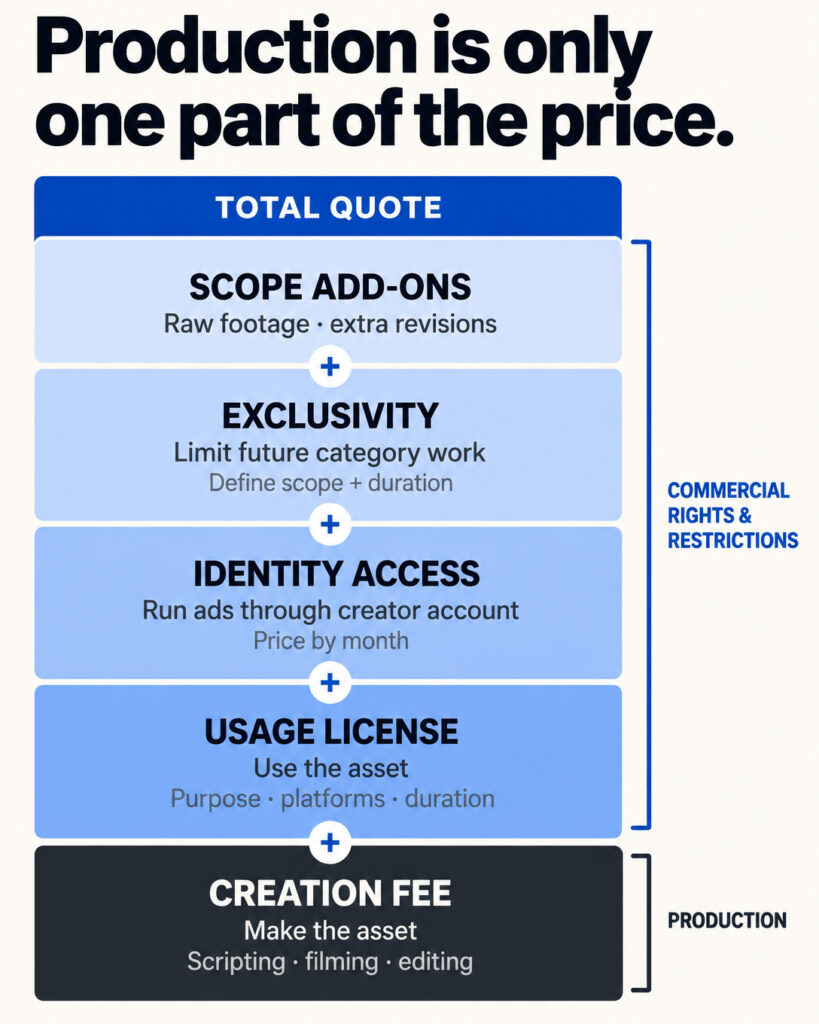
The money in UGC moves through a specific set of mechanics, and once you can see those mechanics, you stop guessing and start pricing like a business. That’s what this article does. I’m going to walk you through exactly how the money moves from brand to creator, line item by line item, so you can build your own rates with confidence.
The Foundation: You Sell Two Separate Things
Every UGC deal contains two distinct products, and this is the single most important thing to understand before you quote another rate.
1. The creation fee. This pays for your time, skill, and production work. Scripting, filming, editing, delivering the file. You earn this fee the moment you hand over the finished content.
2. The usage license. This pays for the brand’s permission to actually use that content. Where they run it, how long they run it, and whether they put ad spend behind it.
These should always be separate line items in your contracts and invoices. When you bundle them into one number, the brand gets unlimited value for a fixed price, and you lose the ability to charge for extended use later.
💡 Tip: Industry guides call usage rights the single biggest factor that inflates UGC costs for brands. Translation for you as a creator: this is where most of your earning power lives.
Step 1: Set Your Base Creation Fee
Your creation fee is the floor of every deal. According to industry data, the median rate for a single UGC video is $150, while the average asking price sits at $212. The average runs higher because experienced creators charge well above the median.
Your base fee should account for:
-
Scripting and concept time
-
Filming and reshoots
-
Editing and captions
-
Props, products, or location costs
-
Your experience level and portfolio strength
Here’s a detail worth acting on today: creators with structured rate cards earn 40% or more than creators who negotiate each project from scratch. A documented pricing system beats improvised negotiation every single time. Build the rate card once, then reuse it.
And the ceiling is higher than many creators assume. Reports show some creators in TikTok’s Creative Challenge beta program earning up to $34,000 a month producing UGC for brands. The market pays serious money. The question is whether your pricing structure captures it.
Step 2: Price the Usage License
Once your creation fee is set, the usage license determines everything else. Think of it as answering three questions: where does the content run, for how long, and with what money behind it.
Organic Usage
Organic usage means the brand posts your content on their own social feeds without putting ad spend behind it. This is typically included in your base creation fee for a limited window, usually 3 to 6 months.
The key word is limited. Put a time boundary on organic use in your contract. When that window closes, the brand renews the license or stops using the content.
Paid Ad Usage
Paid usage means the brand runs your content as an advertisement with budget behind it. This is a fundamentally bigger ask. They’re using your face, your voice, and your credibility to sell a product at scale, and they’re generating direct profit from it.
Standard benchmarks:
-
Monthly or quarterly paid usage: an additional 30% to 50% of your base creation fee per period the ad runs
-
90-day paid license: adds 50% to 100% on top of the base fee
-
12-month ad rights: 50% to 100% of the base creation fee is the standard in 2026
-
Perpetual or evergreen licenses: 2 to 3 times the base rate
Duration is the lever. A 30-day license and a forever license are completely different products, and your pricing needs to reflect that.
Step 3: Charge a Premium for Whitelisting
Whitelisting, sometimes called Spark Ads on TikTok, means the brand runs paid ads directly through your account instead of their own. The ad appears to come from you personally.
This commands a premium for a structural reason: ads running through your account preserve your engagement data and typically outperform brand-run ads. The brand is renting your identity and your social proof.
Standard pricing adds 30% to 100% per month on top of your base rate. In dollar terms, whitelisting fees typically range from $200 to $1,500 per month, and engagement rate and niche fit matter more than follower count in setting that number.
⚠️ Warning: Price whitelisting as its own line item with its own monthly term. Never fold it into a flat project fee. Your account’s performance history is an asset, and assets get rented by the month.
Step 4: Price Exclusivity Like the Restriction It Is
Exclusivity clauses prevent you from creating similar content for competing brands. Every exclusivity clause costs you future income, so it has to be compensated.
Standard benchmarks:
-
Category exclusivity for a defined period: add 50% to 100% of your base rate
-
Full buyout, where the brand owns the content forever and locks you out of the category: 200% to 500% of your original creation fee
Before you agree to any exclusivity, define three things in writing: the exact category (skincare, for example, rather than “beauty”), the duration, and the premium. Vague exclusivity language quietly removes entire industries from your client list.
Step 5: Handle Revisions and Raw Footage in the Contract
Two smaller mechanics still move real money.
Revisions
Specify the number of included revision rounds in your contract. One or two rounds is standard. Additional rounds get billed at a defined rate. Without this clause, a single project can balloon into weeks of unpaid re-edits.
Raw Footage
Raw, unedited footage lets a brand recut your content into endless formats. That repurposing power has a price: an additional 30% to 50% of your base rate is the industry standard. Handing over raw files for free hands over your entire shoot’s value for the cost of one deliverable.
A Simple Rate-Building Example
Here’s how these mechanics stack into an actual quote. Let’s say your base creation fee is $150 and a brand wants one video with 3 months of paid ad usage at 25% per month.
Creation fee: $150
Paid usage license: $150 x 0.25 x 3 months = $112.50
Total project fee: $262.50
Now extend the same deal. The brand also wants raw footage (+40%) and whitelisting for one month (+$300):
Creation fee: $150
Paid usage, 3 months: $112.50
Raw footage: $60
Whitelisting, 1 month: $300
Total project fee: $622.50
Same video. Same effort on your end. The difference between $150 and $622.50 is entirely in understanding the mechanics and itemizing them.
One more structural note: brands buying in volume expect a discount, and the data backs this up. Bundle discounts for multiple UGC videos average around 19%, which translates to roughly $170 per video instead of $212. Volume discounts are a legitimate tool when the total deal value grows.
What You Should Negotiate in Every Contract
Before you sign, confirm the contract defines each of these in writing:
-
Creation fee as its own line item
-
Usage type: organic only, paid ads, or both
-
Usage duration with a hard end date
-
Platforms where the content runs
-
Whitelisting terms priced monthly, if applicable
-
Exclusivity scope, category and duration, with a premium attached
-
Revision rounds included, plus the rate for extras
-
Raw footage priced separately, if requested
-
Payment terms: deposit, due date, and late fees
Many new creators rely on verbal agreements, DM confirmations, or generic templates. The documented result of that approach includes disputes over revisions, confusion about platform usage, and creators unknowingly signing away perpetual ad rights for a flat $150 fee. A written contract with these nine items solves nearly all of it before it starts.
Why This Knowledge Changes Your Position
Public data suggests 90% of consumers prioritize authenticity, which makes your likeness genuinely valuable for paid media. Brands know this. The creators who understand licensing mechanics negotiate from that same knowledge and get paid accordingly.
Pricing becomes systematic once the invisible parts of the deal become visible. You stop wondering whether your quote is fair because every number maps to a specific right the brand is purchasing. That clarity makes negotiations faster, contracts cleaner, and your income more predictable.
Build your rate card this week. List your base fee, your usage percentages, your whitelisting rate, your exclusivity premiums, and your raw footage add-on. Then send that structure with every pitch. The system does the negotiating for you.
FAQ: UGC Contracts and Rates
What is the difference between a creation fee and a usage license?
The creation fee pays for producing the content itself: scripting, filming, and editing. The usage license pays for the brand’s permission to use that content, defined by platform, purpose, and duration. Quote them as separate line items in every deal.
How much should I charge for paid ad usage?
Standard benchmarks add 30% to 50% of your base creation fee per month or quarter the ad runs. A 90-day license commonly adds 50% to 100% of the base fee, and 12-month rights run 50% to 100% as the 2026 standard.
What is whitelisting and why does it cost more?
Whitelisting means the brand runs paid ads through your account rather than their own. It costs more because your engagement data stays attached to the ad and those ads typically outperform brand-run versions. Expect to charge 30% to 100% of your base rate per month, which in practice lands between $200 and $1,500 monthly.
Should I ever agree to a perpetual buyout?
Yes, at the right price. Perpetual or buyout rights, where the brand owns the content forever and restricts you from competitors, typically run 200% to 500% of your original creation fee. Agree only when the premium reflects the income you’re giving up.
What should a beginner UGC creator charge?
The median rate for a single video is $150, with the average asking price at $212. Start near the median, document your rates in a rate card, and raise your base fee as your portfolio and results grow. Creators with structured rate cards earn 40% or more than those who negotiate project by project.
Do I need a formal contract for small deals?
Yes. Verbal agreements and DM confirmations create disputes over revisions, platform usage, and ad rights. Documented cases show creators signing away perpetual ad rights for a flat $150 because nothing was defined in writing. A one-page contract covering fees, usage, duration, and revisions protects every deal regardless of size.