Meta description: Cleaning videos earn through affiliate commissions, Amazon storefronts, UGC brand deals, and platform payouts. I break down the exact numbers and mechanics behind each stream.
I spend a lot of time reverse-engineering how content turns into income. Cleaning videos kept coming up in conversations with my students, usually with the same confusion attached.
The videos look simple. Someone deep-cleans a sink, restocks a fridge, or organizes a pantry. The views pile up. And the creator quietly builds a real business behind the camera.
Today I want to show you exactly how that business works. The actual revenue streams, the actual commission rates, and the actual math. Once you see the structure, you can build it yourself.
The Cleaning Video Monetization Stack
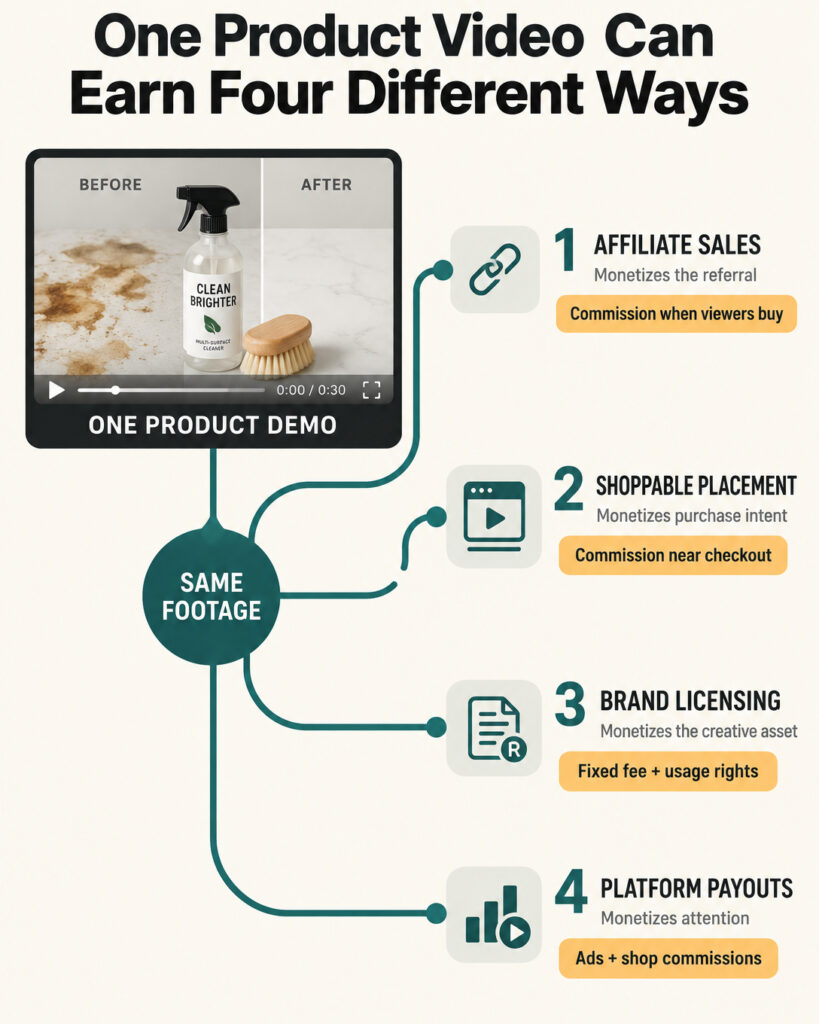
A cleaning creator earning real money runs four revenue streams at once, stacked on top of the same content:
-
Affiliate commissions on the products shown in the video
-
Amazon Influencer storefronts with onsite shoppable videos
-
UGC brand deals, where brands pay for the video itself
-
Platform payouts from TikTok Shop and YouTube ad revenue
Each stream pays differently. Each one has its own mechanics. I will walk you through all four with numbers, because the numbers are what make this real.
Stream 1: Affiliate Commissions on Cleaning Products
Every cleaning video is a product showcase whether the creator planned it that way or not. The scrub brush, the degreaser, the drawer organizers. Viewers ask “what is that” in the comments constantly.
Affiliate links answer that question and get the creator paid.
How the math works
Through the Amazon Influencer Program, commission rates run from 1% to 20% depending on the product category. Home and cleaning-adjacent categories like Furniture, Home, Home Improvement, Lawn and Garden, and Pet Products typically pay 3%.
That sounds small until you run the volume math. A video showing a $40 vacuum attachment that sends 200 buyers through your link earns you $240 at 3%. One video. One product. And most cleaning videos feature five to ten products.
💡 Tip: Affiliate content keeps earning long after you publish it. Search-optimized videos on YouTube and blog posts bring in commissions for months, sometimes years, because people keep finding them through search. Short-form platforms fade faster.
This is why I push my students toward searchable platforms as their foundation. A TikTok earns for days. A blog post or YouTube video earns on a loop.
Stream 2: Amazon Influencer Storefronts and Shoppable Videos
This stream is underused and I want to spend real time on it, because the mechanics are different from standard affiliate links.
When you qualify for the Amazon Influencer Program, you get a storefront. You also unlock something more valuable: the ability to upload shoppable videos directly onto Amazon product pages.
Why onsite placement matters
Your cleaning demo of a carpet spot cleaner can appear on that cleaner’s actual product page. Shoppers already intend to buy. Your video answers their last question, and you earn the commission when they check out.
The rates split into two tracks. On-site and off-site rates differ by category. Home Improvement pays 4% on-site and 3% off-site, while the “All Other Categories” bucket pays 2% on-site and 4% off-site.
That dual-rate structure changes your strategy. For some products, pushing traffic from social media earns more. For others, the video sitting on the Amazon page itself earns more. You want both placements working for you.
Commissions process after delivery, typically 15 days post-purchase. I cover the full qualification process and realistic income ranges in my post on Amazon Influencer earnings, and I break down the upload workflow in my guide to shoppable videos.
⚠️ Warning: You film these videos once. Amazon serves them to shoppers indefinitely. Creators who treat this as a one-time batch project instead of an ongoing system leave the biggest returns on the table.
Stream 3: UGC Brand Deals
Here is the stream that surprises my students the most. Cleaning brands pay creators for videos without requiring the creator to post them anywhere.
This is UGC, user-generated content. The brand licenses your video to run in their own ads. Your follower count barely matters. Your ability to make a product look good on camera matters a lot.
What brands actually pay
The median rate sits around $175 per single UGC video, and content-only deals typically run $150 to $300 per video. Rates climb with experience:
-
Beginners (0 to 12 months): $100 to $250 for product demos, $150 to $400 for scripted short-form video
-
Mid-level (1 to 3 years): $400 to $800 for demos, $400 to $1,000 for scripted videos
-
Experienced (3+ years): $800 to $2,000 for demos, $1,000 to $2,500 for scripted short-form video
Usage rights add real money on top. Brands pay a 30% premium for 30 days of paid ad usage, or 50% for 90 days. Whitelisting, where the brand runs ads through your account, adds another 30% to 50% monthly. Rush delivery inside 48 hours adds 25% to 50%.
Monthly retainers for producing 4 to 8 videos for one brand run $800 to $3,000 per month. For a cleaning creator who already films products daily, a retainer converts existing skill into predictable income.
Fixed-fee UGC projects commonly land in the $500 to $1,500 range per project, with current listings running from $250 to $2,500+ per project.
Cleaning is a strong UGC niche because the before-and-after format sells products visually. A grimy stovetop turning spotless is the ad. Brands know it.
Stream 4: Platform Incentives from TikTok Shop and YouTube
The platforms themselves pay you, and the structures differ enough that you should understand both.
TikTok Shop affiliate commissions
TikTok Shop affiliate rates in the US average around 13%. Open-plan rates run from roughly 5% on electronics up to 30% on beauty and wellness products, and targeted collaborations with proven creators reach up to 50%.
The payout math on a single sale: a viewer buys a $50 product through your link, TikTok takes its 6% transaction fee of $3, and at a 15% brand commission rate you receive $7.50. Settlement runs automatically every 14 days with no invoicing. Average commission per sale lands between $12 and $45 depending on category and tier.
Scale matters here. TikTok Shop drove an estimated $15.1 billion in US gross merchandise value in 2025, and its 4.7% average conversion rate outperforms traditional e-commerce’s 2% to 4%. Viewers on that platform buy at higher rates, which makes every product demo more valuable.
You need 5,000 followers for full Open Plan access. Creators between 1,000 and 5,000 followers can enter a 30-day pilot program, so the entry bar is lower than it looks.
YouTube ad revenue
YouTube pays creators 55% of ad revenue. RPM ranges from $1.61 to $29 per 1,000 views depending on niche, audience location, and content type.
At the channel level, around 100,000 subscribers typically produces $1,000 to $3,000 per month from ads alone, and 500,000 subscribers often generates $5,000 to $15,000 monthly. YouTube has paid creators over $70 billion in recent years, which makes it the most proven payout engine on this list.
Treat ad revenue as your baseline. The creators earning the most layer brand deals, memberships, and affiliate income on top of it.
Why Stacking Beats Picking One Stream
Single-stream creators carry structural risk. The income data makes this clear: only 4% to 9% of creators earn $100,000+ annually, and over half earn under $15,000. Diversification is what separates the two groups more than talent does.
The encouraging part is that the money exists. The creator economy sits at roughly $234 billion in 2025, with US ad spend on creators reaching $37.1 billion and projected to hit $43.9 billion in 2026. Brands keep increasing their budgets.
One cleaning video can feed all four streams at once:
-
Post it on TikTok with Shop links attached.
-
Upload a version to YouTube for ad revenue and long-tail affiliate clicks.
-
Cut a product-focused segment and upload it as a shoppable video on Amazon.
-
Pitch the same style of footage to the brand as paid UGC.
Four paychecks. One filming session. That is the system working for you instead of you working for the algorithm.
Your First Steps This Week
You can start this without a large audience. Here is the order I recommend:
-
Step 1: Apply to the Amazon Influencer Program and list every product you already use on camera.
-
Step 2: Film three shoppable videos for products you own. Keep them under 60 seconds, show the product solving a problem.
-
Step 3: Build a simple UGC portfolio page with those same videos and pitch five cleaning or home brands at beginner rates.
-
Step 4: Grow toward 1,000 TikTok followers to enter the Shop pilot program, then 5,000 for full access.
-
Step 5: Repurpose everything onto YouTube so your content keeps earning through search.
Document what each stream pays you monthly. The numbers will tell you where to invest more filming time.
FAQ: Cleaning Video Monetization
How many followers do I need to start earning from cleaning videos?
Fewer than you expect. UGC brand deals require no audience at all, since brands license the video for their own ads at $150 to $300 per video for beginners. TikTok Shop’s pilot program opens at 1,000 followers. The Amazon Influencer Program reviews your engagement rather than demanding a huge following.
Which stream pays fastest?
UGC deals pay fastest because you invoice a flat fee per video. TikTok Shop settles automatically every 14 days. Amazon commissions process about 15 days after delivery. YouTube ad revenue builds slowest but compounds the longest.
Do cleaning products pay decent affiliate commissions?
The rates are modest, typically 3% in home-related Amazon categories, and the volume compensates. Cleaning products are low-cost, high-frequency purchases, so conversion rates run high. On TikTok Shop, home and wellness-adjacent categories pay considerably more, with open rates reaching up to 30% in beauty and wellness.
Can I do this with just a phone?
Yes. Shoppable videos and UGC content perform well with natural light and a stable phone shot. Brands buying UGC want authentic-looking footage, so an over-produced studio setup can actually work against you.
How much can a cleaning creator realistically earn per month?
A beginner stacking four UGC deals ($600 to $1,200), early affiliate commissions, and small platform payouts can reach $1,000+ per month within their first year. Established creators layering retainers, Amazon onsite earnings, and YouTube ads scale well past that, since channels with 100,000 subscribers earn $1,000 to $3,000 monthly from ads before any other stream counts.
The Path Is Visible Now
Cleaning videos look like entertainment and operate like a storefront. Affiliate links, Amazon shoppable placements, UGC licensing, and platform payouts all run off the same footage.
You now have the rates, the entry requirements, and the order of operations. The mystery is gone, which means the only remaining step is yours to take.
If you want the deeper mechanics, start with my breakdown of Amazon Influencer earnings and my step-by-step guide to shoppable videos. Film your first product video this week. The system starts working the day you start feeding it.