Meta description: CleanTok has billions of views and real monetization paths behind it. Here is the data on why cleaning content performs and how creators turn it into income through affiliate links, Amazon shoppable videos, UGC, and brand deals.
When I tell new bloggers and content creators to look seriously at cleaning content, I sometimes get a polite smile. They assume I am pointing them toward a quirky corner of TikTok where people scrub grout for fun.
Then I show them the numbers.
#CleanTok has logged roughly 2.4 billion organic views across tracked videos, with the average video pulling near 561,000 views, according to CleanTok statistics. Broader hashtags like #cleanwithme and #cleaningmotivation add more than 20 billion combined views on top of that.
Those are category numbers, built over years, backed by a product market worth hundreds of billions of dollars. I treat CleanTok the way I treat any income-producing asset: I reverse-engineer why it works, then document the path so you can walk it faster.
That is exactly what this article does.
Why Cleaning Content Performs So Consistently
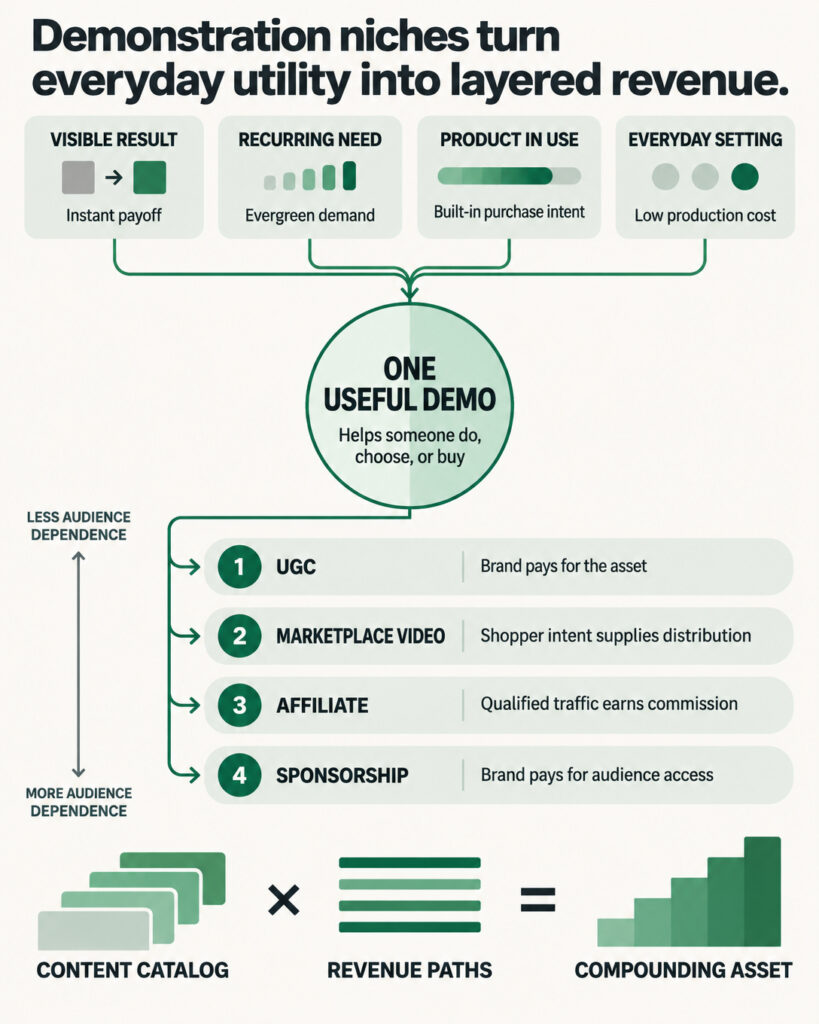
Before you monetize a content category, you need to understand the mechanics underneath it. Cleaning content performs for four structural reasons, and each one is verifiable.
1. The visuals do the selling for you
A before-and-after transformation is the simplest story format in existence. A dirty stovetop becomes a spotless one in 30 seconds. Viewers feel the payoff without needing context, backstory, or even sound.
This matters for distribution. TikTok produces 1.6x more viral content around niche subcultures like CleanTok than Instagram Reels does, based on TikTok platform data. The platform actively rewards this kind of satisfying, self-contained content.
2. The audience is nearly universal
Everyone who lives in a home deals with cleaning. Students, parents, renters, homeowners, apartment dwellers. There is no demographic ceiling, which means the algorithm never runs out of people to show your videos to.
Compare that to a niche like watch collecting or drone photography, where the audience pool caps out early.
3. The barrier to entry is your own kitchen
You already own the set, the props, and the subject matter. A phone, decent lighting, and a messy counter are the full startup cost.
Here is the part that is commonly overlooked: small accounts hold a genuine advantage. Creators with under 10,000 followers average an 8.1% engagement rate on TikTok, more than double the 3.7% rate for accounts above 500,000 followers. You do not need an existing audience to start earning attention in this category.
4. The demand never expires
A video about removing hard water stains will still answer the same question five years from now. That makes cleaning content an evergreen asset, and evergreen assets compound.
The market behind it keeps growing too. The household cleaning products market was valued at $147.44 billion in 2026 and is projected to reach $210.29 billion by 2030, growing at 9.3% annually, per market research. Brands in a growing market need creators to reach buyers. That spending flows directly into the monetization paths below.
The Four Monetization Paths Behind CleanTok
Views alone pay very little. The income comes from stacking monetization systems on top of content you were already going to make. Here are the four that work in this category, in the order I recommend building them.
Path 1: Affiliate marketing
This is your foundation. Every cleaning video naturally features products: sprays, brushes, steam mops, organizers. Adding a trackable affiliate link turns each video into a small storefront.
The earning ceiling is higher than many creators expect. The average affiliate marketer earns $8,030 per month according to Authority Hacker. YouTuber Charlie Chang built a system where 80 percent of his income flows from affiliate marketing, with 1.3 million subscribers, and his approach centers on serving a specific audience with high-value content rather than chasing viral spikes.
That lesson transfers directly to cleaning content. Helpful, specific product recommendations convert. Generic hauls do not.
Path 2: The Amazon Influencer Program
This one deserves special attention because it fits cleaning content perfectly.
The Amazon Influencer Program places your shoppable videos directly on product detail pages. Someone shopping for a grout brush sees your demo video right on the listing, watches it, and buys. You earn a commission, and you never had to send them there yourself.
The numbers work like this:
-
Commission rates range from 1% to 20% per sale depending on product category, with influencers earning up to 10% on many products
-
Some creators in the program earn $4,000 to $5,000 monthly
-
Amazon’s algorithm shows videos that generate purchases, clicks, and watch time to new customers, so strong videos earn passive on-site views over time
Cleaning products are high-volume, repeat-purchase items. A 60-second demo of a product you already use can earn commissions for months. This is the clearest example I know of turning content into a documented, recurring asset.
Path 3: UGC for cleaning brands
User-generated content flips the model. Brands pay you a flat fee to create videos they run as their own ads. You do not need followers at all, since the brand buys the content itself.
For creators building their first income stream, UGC removes the audience-building timeline entirely. Your portfolio is simply the cleaning videos you already make, pointed at a brand’s product.
Path 4: Brand deals and sponsorships
Once your account has traction, sponsorships become the highest-leverage path. A single brand deal for cleaning content creators can outweigh ad revenue by 10x. For context, a video generating 100,000 views earns roughly $300 to $1,000 in ad revenue alone, and a sponsorship multiplies that substantially.
The broader creator economy supports this trajectory. Creators making everyday content about cooking dinner and cleaning house report monthly earnings of $30,000 to $50,000 through platform monetization, with some reaching seven figures in under four years. Those are outlier outcomes, and I want to be honest about that. The structure underneath them is repeatable even when the scale is not.
How to Start Without Overcomplicating It
The biggest risk in this category is overthinking. The path is simple enough to write down in five steps.
-
Pick one sub-niche. Small-space cleaning, pet households, speed cleaning for working parents, or non-toxic products. Specificity builds trust faster than breadth.
-
Film with what you have. Your phone, natural light, and real messes. Polished production hurts relatability in this category.
-
Post consistently for 60 days. Transformations, product tests, and routines. Watch which format earns saves and shares, then double down.
-
Apply to the Amazon Influencer Program and one affiliate network early. Optimize your video titles and captions with core keywords plus use cases, since that is what Amazon’s algorithm rewards.
-
Document your results. Your growth story becomes your pitch for UGC work and brand deals later.
Systems beat motivation every time. Treat these five steps as a checklist you execute, and the momentum takes care of itself.
What the Data Says About Timing
Entering a category late is a real concern, so let me address it with numbers instead of reassurance.
TikTok’s average engagement rate sits at 3.85% to 4.25%, roughly 7 times higher than Instagram’s 0.48%. Shares per post on TikTok grew 45% year over year. Engagement in this ecosystem is still climbing, and viewers are distributing content organically at increasing rates.
On the spending side, the affiliate marketing industry is projected to reach $27.78 billion by 2027. The global cleaning products market is expected to reach $275.22 billion by 2033.
Demand for the content is growing, the money behind the products is growing, and the infrastructure for creators to capture both is already built. That combination defines a category worth entering, in my experience.
The window is open. The work is in showing up with a system.
FAQ: CleanTok Monetization
Do I need a big following to make money with cleaning content?
No. Accounts under 10,000 followers average an 8.1% engagement rate on TikTok, higher than large accounts. UGC work requires zero followers. The Amazon Influencer Program rewards video performance on product pages rather than your follower count.
How much can I realistically earn as a beginner?
Start with modest expectations. Early income typically comes from affiliate commissions and small UGC contracts. As a reference point, some Amazon influencers earn $4,000 to $5,000 monthly, and the average affiliate marketer earns $8,030 per month. Plan on months of consistent posting before income becomes meaningful.
Which monetization method should I set up first?
Affiliate links, because they attach to content you are already making. Apply to the Amazon Influencer Program as soon as you have a small body of work, since shoppable videos on product pages earn passively.
Is cleaning content oversaturated?
The category is large, and the demand behind it keeps growing. The household cleaning products market is projected to grow at 9.3% annually through 2030. Specificity is your entry point. A tightly defined sub-niche, like non-toxic cleaning for families with toddlers, gives you room that broad “cleaning tips” content does not.
What equipment do I need to start?
A smartphone and good lighting. Authentic, over-the-shoulder style footage performs well in this category, so expensive gear can wait until the income justifies it.
The Takeaway
Cleaning content checks every box I look for in an income-producing asset: evergreen demand, low startup cost, built-in product integration, and multiple monetization systems that stack on top of each other.
The path is visible. The data confirms it works. Your first step is picking a sub-niche and filming one video this week.
Once you start treating your content as an asset instead of a hobby, everything about how you build changes. That shift is the real lesson CleanTok teaches, and it applies to every niche you will ever enter.