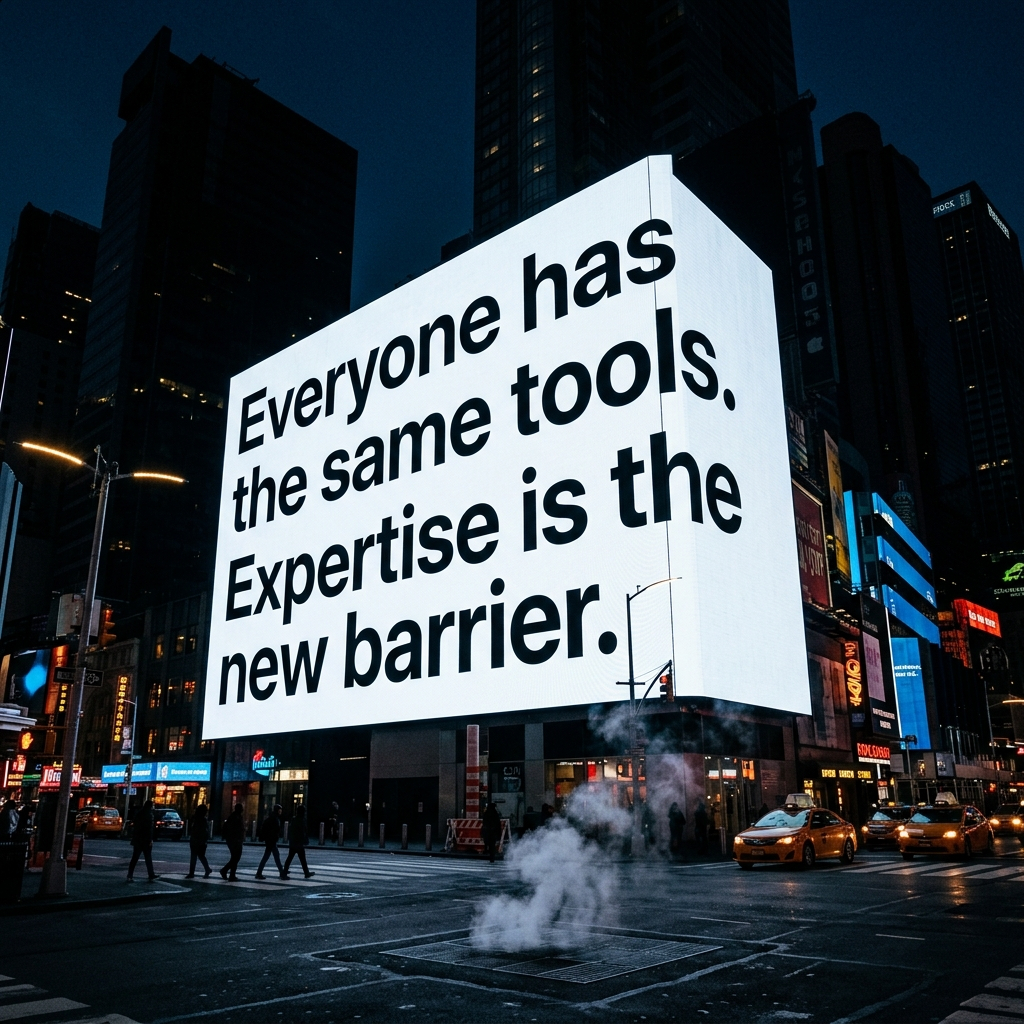
Between 2024 and 2026, the barrier to building a niche site dropped to almost nothing.
Spinning up WordPress sites, bulk-generating 50 articles, and handling basic SEO research could be achieved in a single weekend.
The tools are real, they’re cheap, and they work. Heck, this article here is an example of leveraging said AI, but of course with a lot of my human touch.
If you still don’t know what AI tools to use, just ask me and I’ll hook you up (with the one I am using for this article, it’s actually AH-Mazing).
FUN FACT: Everyone else has access and are using these same tools (You know tools like ChatGPT, Claude, Gemini and more).
In 2024, there were 82 million AI-assisted web pages published monthly.
By 2026, that number hit 312 million.
The average cost of producing a 2,000-word article dropped 44% in two years. 97% of content marketers plan to use AI this year.
The gold rush happened and you may have missed the part where just showing up was enough.
The Flood Is Already Here
Right now, 74.2% of newly published web pages contain detectable AI-generated content.
Projections suggest that number will hit 90% by the end of 2026.
Think about what that means for your niche site strategy.
You’re not competing against a handful of established blogs anymore. You’re competing against an ocean of competent, well-structured, perfectly optimized content that was generated in bulk by people who figured out the same AI workflow you did.
Google knows this. Readers know this.
52% of consumers reduce engagement when they suspect AI-generated content. They can feel it. The pattern recognition is getting sharper on both sides.
I, personally know when people are using AI, especially because most of the time a lot of the content can be unusually extensive and too comprehensive at times.
Google’s March 2026 core update made it official: AI content farms lost between 60 and 80% of their traffic overnight. Sites with original content saw visibility gains averaging 22%.
The algorithm didn’t penalize AI. It penalized volume without expertise.
Content Alone Is No Longer the Moat
I’ve watched this play out in real time.
Sites that were ranking under the old algorithm started dropping. Not because the content was bad. Not because it was thin. But because it lacked something Google started prioritizing: demonstrable firsthand knowledge.
The March 2026 update drove some of the highest ranking volatility on record. Roughly 80% of top-three results shifted. Nearly 1 in 4 top-10 pages fell out of the top 100 entirely.
What survived?
Sites with detailed author credentials. Sites with interconnected content clusters. Sites that showed they understood the topic deeply, not just algorithmically.
You know, as the SEOs call it the EEAT factor. EEAT stands for Experience, Expertise, Authority, and Trust.
73% of top-ranking pages now feature detailed author credentials following the update. That’s not a coincidence.
The old “publish and wait” strategy is dead. You can’t just generate 100 articles on random keywords and expect traffic to show up.
Winners Are Building Topical Authority Clusters, Not Random Posts
Here’s what’s working right now.
A site with 20 interconnected articles on a specific subject will consistently outrank a site with one 5,000-word guide on the same subject. Even if the single article is technically superior in isolation.
Sites that implement content clusters correctly see an average 40% increase in organic traffic compared to non-clustered strategies. Some businesses report traffic increases ranging from 50% to 300% within 6 to 12 months.
This is the shift. This concept was originally coined Koray Tugberk GUBUR (check out his youtube channel here: https://www.youtube.com/@TopicalAuthority).
You’re not trying to rank for one keyword anymore. You’re trying to become the authoritative source on a specific topic. That means depth, not breadth. That means using AI to go deeper and faster on a niche you actually understand.
This is a solid strategy and actually like a fun research project in my opinion.
Human experience + AI execution speed = the new competitive edge.
I’ve seen people use AI to map out competitor gaps, identify content opportunities, and draft 30 articles in a week. But the ones who win are the ones who add their own insights, their own examples, their own voice (as seen in this article for example).
The AI handles the structure. You handle the expertise (you literally have to add your user profile at the bottom of each article, and have like an about me page at minimum, + extra points when you connect your real world social profiles to the blog/publishing channel).
Three Things That Still Require a Human
Let me be direct about what AI can’t do for you.
1. Choosing the right niche.
AI can analyze search volume, competition, and monetization potential (my favorite tool is Ahrefs of course).
But it can’t tell you which niche you’ll actually stick with for 12 months. It can’t predict which topics you’ll have genuine insight into (passion matters). It can’t sense when a market is about to shift.
The affiliate marketing industry is worth $17 billion globally in 2026. A well-built affiliate site with 100+ articles can earn $5,000 to $50,000 per month within 12 to 24 months. But only if you pick a niche you can commit to.
2. Building trust with an audience.
74% of content marketers use AI for ideation (this is how I use it most, as well)
61% use it for outlining.
44% use it for drafting.
But only 1% say 100% of their work is generated by AI.
Even the AI adopters know pure automation doesn’t work.
Trust comes from consistency, transparency, and showing up as a real person. You can’t automate that. You can accelerate it with AI tools, but the relationship part is all you.
3. Stacking revenue streams once traffic comes.
Getting traffic is one thing. Monetizing it is another (and this strategy is what I am an expert in, so please reach out).
AI can help you identify affiliate programs, draft product reviews, and optimize conversion paths.
But it can’t tell you which revenue model fits your audience best. It can’t negotiate partnerships. It can’t build the business infrastructure around your site.
SEO delivers 748% ROI with a 7 to 9 month breakeven. It’s the highest returning B2B marketing investment available.
But you have to know how to capture that value. It’s why huge companies continue to hire content marketers, SEO specialists, and experienced digital marketers.
The Search Landscape Itself Has Fundamentally Shifted
AI Overviews now appear on 48% of Google queries as of April 2026, reaching 2 billion monthly users.
This changes everything about how people find content.
The old SEO playbook was built for a world where people clicked through to your site. Now, Google answers the question directly. Your content needs to be good enough that people click through anyway.
To be absolutely honest, I think showing up as a result for search queries just really depends on how well you are solving and answer questions and problems.
The actual real reason people continue to go on websites is because they themselves want to do deeper research and have better understanding on the topic that they’re searching. Unless they want shallow answers, then that’s on them really.
But with regards to overall search results, you’re not just optimizing for rankings – You’re optimizing for trust, depth, and genuine value that can’t be summarized in an AI Overview.
SEO strategy in 2026 prioritizes conversion, engagement, and business impact over sheer content volume. I would also add that having a multi pronged approach to visibility online helps a lot too so having a page on Youtube or even another video oriented platform can help.
Publishing dozens of blogs with overlapping topics dilutes authority instead of strengthening it.
Search systems favor focused, high-performing pages.
What This Means for You Right Now
If you’re building a niche site in 2026, you’re not competing on content production speed anymore. You’re competing on expertise, trust, and strategic positioning.
Use AI to handle the heavy lifting. Let it draft outlines, generate variations, research keywords, and map content clusters. But don’t let it replace your judgment.
The winners right now are the people who combine AI speed with genuine topical authority. They’re the ones who understand that the tools lowered the barrier to entry, but they also raised the bar for quality.
You can still build a profitable niche site. The opportunity is real. Website, blog, and SEO is still the number one ROI-generating channel according to marketers in 2026.
But you need a strategy behind the site, not just the tools.
You need to know which niche to pick, how to build topical authority clusters, and how to monetize traffic once it shows up. You need to understand the fundamentals that still matter even when the tactics change.
That’s what I teach inside the Inspired to Blog programs. The strategy behind the site. The part that AI can’t do for you.
If you want to build something that lasts longer than the next algorithm update, you need more than bulk-generated content. You need a framework.
The gold rush is over. But the real builders are just getting started.